
In the past couple of years, full-stack developers are in huge demand, and one of the leading technology stacks for web development is — MERN stack. This stack is heavily used by Companies, Startups, and Tech organizations to develop scalable and dynamic web apps. The MERN stack has evolved to be one of the most beginner friendly and powerful stacks to learn, because all parts of this development process are written in JavaScript.
The MERN stack is a perfect combination to learn and start your career as a professional web developer in the coming future. You could be on a full-stack developer position, You could build your own SaaS product, you can work remotely for different companies across the globe or get started with freelancing.
But beginners often struggle to learn technologies in random order instead of giving a clear roadmap. A MERN developer journey includes learning various tools, mastering concepts of programming, and building real-world applications.
In this ultimate guide, I am going to provide you a full step by step roadmap with detailed explanations and numbered lists that will help you in knowing how exactly you can become a MERN stack developer 2026.
Table of Contents
ToggleWhat is the MERN Stack?
The first step before jumping, is to understand what exactly does MERN mean?
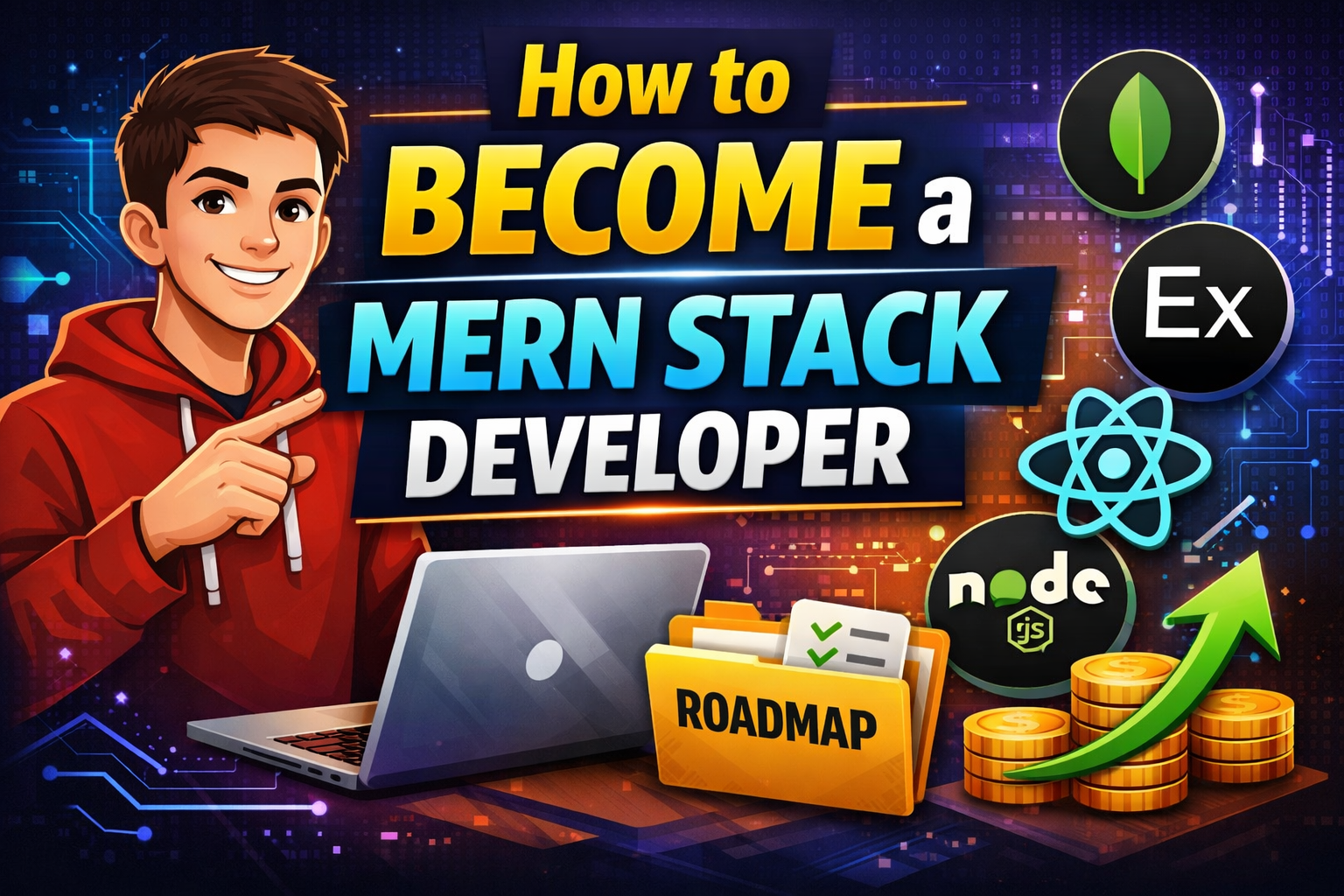
MER= MongoDB, ExpressJS and ReactJS, with NodeJS.
The MERN Stack Includes
- MongoDB – the database where application data is stored
- Express.js — API backend framework
- React.js – The library that you will use to build the frontend
- Node.js – Server-side JavaScript execution runtime environment
Each one of the above technology plays a role across the development process.
So when a user submits a form on the web, there are different stages it passes through. React is for the user interface where this form exists. Node. js & Express handles the request on Server side. Last but not least, MongoDB saves the data in the DB.
This combination enables developers to build powerful web applications using JavaScript alone.
Reasons Why MERN Stack and What You should Know in 2026
The MERN stack remains the most dependable framework in the web development ecosystem owing to its versatile infrastructure and rich community support.
However, the MERN stack is still a great career choice in 2026 for a variety of reasons.
Top Reasons to Learn MERN Stack
- JavaScript everywhere
Since MERN uses Javascript for both front-end and back-end development, it becomes easier to learn.
- High job demand
Companies look for developers who has knowledge of both frontend and backend.
- Huge ecosystem
React and Node. There are thousands of libraries and tools available for development in js.
- Startup friendly
For startups, MERN is often the best option as it enables speedy product building.
- Strong community support
Tutotials, documentation and opensouce projects are easily available for developers.
Due to these benefits MERN developers are still in high demand when hiring.
Step 1: Understand Web Development Fundamentals
Beginners have to know the basic working of how websites work, before diving into MERN technologies. This step is overlooked by many, and it shows later on when learning frameworks.
Three primary technologies are the foundation for web development.
When You Should Avoid Learning Certain Core Technologies
- HTML – HTML is used to structure web pages
- CSS – Used for all interface design and styling
- JavaScript – Enables functionality and interactivity
These three technologies are the core of modern web development.
For instance, HTML specifies the structure of a webpage, CSS determines how it appears and JavaScript manages its behavior when users engage with it
Having a good foundation, will make it easier to learn React and Node. js will become much easier.
Step 2: Understanding HTML and Semantic Markup
Every single website has HTML as its skeletal structure. It describes the structure of content on a page.
The concepts you need to learn related HTML are:
Important HTML Concepts
- Semantic tags
- Forms and input fields
- Tables and lists
- Media elements (images, video, audio)
- Accessibility principles
Semantic HTML is crucial for improving search engines understanding of your website structure and better accessibility of content for users with disabilities.
Somewhere developers have to use more meaningful elements instead of common elements everywhere such as headers, navigation sections, articles etc.
Learning HTML also further ensures you write clean, organised structures when writing React components later.
Step 3: Master CSS for Twinkling UI
Once you master teaching of HTML, it is time to start designing beautiful interfaces using CSS.
CSS governs the presentation of Websites, such as layout, spacing, colors typography and animations.
Most Important CSS Concepts That You Should Learn
- CSS selectors and properties
- Flexbox layout system
- CSS Grid
- Responsive design
- Media queries
Responsive design is very significant since users use different devices like smartphones, tablets and laptops to access websites.
Today developers use CSS frameworks for faster development as well.
Popular CSS Tools
- Tailwind CSS
- Bootstrap
- Material UI
But you need to learn core css first before you depend on frameworks.
Step 4: Learn JavaScript Deeply
MERN stands for the four components of the stack, which are: JavaScript The entire stack—from React to Node. js—depends on it.
You must gain knowledge of the various concepts associated with JavaScript thoroughly to be a good MERN developer.
Essential JavaScript Topics
- Variables and data types
- Functions and arrow functions
- Arrays and objects
- Loops and conditional statements
- DOM manipulation
- Event handling
After you have understood the basic knowledge, take a step to scenarios with advanced concepts.
Advanced JavaScript Concepts
- Closures
- Prototypes
- ES6 modules
- Promises
- Async/Await
- Event loop
However these advanced topics are very crucial when developing scalable applications.
Step 5: Figure Out Git and Version Control
Professional developers rarely work alone. They work with teams and keep track of code changes with version control systems.
Git is the # 1 most widely used version control system in the world.
Git is the # 1 most widely used version control system in the world.
Important Git Skills
- Initializing repositories
- Creating branches
- Merging code
- Resolving conflicts
- Commit history tracking
Platforms like GitHub are also used by developers to host the projects online.
Having a bulk of your individual projects in an active GitHub profile can greatly help you get hired.
Step 6: Learn React for the Front-End Development
React is the next step after you are comfortable with JavaScript.
It is used to develop fast and interactive UI of web apps.
Core React Concepts
- JSX syntax
- Functional components
- Props and state
- Event handling
- Conditional rendering
React applications are composed of small encapsulated units called components that manage their own state.
Once you have a grasp on the basics, you should also dig into modern React features.
Advanced React Topics
- React Hooks (useState, useEffect)
- Context API
- React Router
- Performance optimization
These tools help developers to create scalable and maintainable frontend applications.
Step 7: Learn Node. js for Backend Development
It is essential to understand backend systems after mastering frontend development.
Node. Expose JavaScript on a non-browser environment to create server-side apps, js.
Key Node.js Concepts
- Node modules
- File system operations
- HTTP servers
- Package management with npm
Node. js is faster as it uses non-blocking architecture where multiple requests can be handled at a time.
This makes it perfect for real-time applications like chat platforms and online collaboration tools.
Step 8: Learn Express. js for API Development
Express. js provides a powerful framework for Node, which makes it easier to develop the backend. js applications.
Important Express.js Features
- Routing
- Middleware
- Request and response handling
- Error management
With Express, developers can quickly build observe system API endpoints that enable frontend applications to interchange knowledge with their backend services.
For instance, If a user logs in to an application, React sends login data to Express API. The server authenticates the credentials and provides a reply.
Step 9: Learn MongoDB for Database Management
Every web application needs a data store because they deal with data.
The following is a NoSQL database in the MERN stack that stores application data.
Important MongoDB Concepts
- Collections and documents
- CRUD operations
- Indexing
- Aggregation pipelines
MongoDB is a very popular NoSQL database that uses flexible JSON-like documents similar to JavaScript objects.
Mongoose is a popular library used by developers to connect with MongoDB, as it enables schema validation and ease of database operations.
Step 10: Create Full MERN Stack Applications
After you have a command over all the techs 3 this step is to connect them and create complete applications.
A full-stack MERN app generally looks like this:
MERN Application Architecture
- React handles the user interface
- Express and Node. js manage backend logic
- MongoDB stores data
- APIs connect frontend and backend
Learning how these components operate in tandem will give you the keys to build scalable applications.
Step 11: Build Real Projects
Building projects is one of the most essential skill to learn as you become a developer.
Employers rarely recruit developers based on theoretical information. They want to see genuine applications.
Beginner MERN Projects
- Todo list application
- Notes management system
- Blog website
- Weather application
Intermediate Projects
- Authentication system
- Chat application
- E-commerce website
- Job portal
Advanced Projects
- Social media platform
- SaaS dashboard
- Online learning platform
- Video streaming service
By working on projects, you get to face some real-world problems and enhance your problem-solving ability.
Step 12: Learn Deployment and DevOps Fundamentals
After building your application, the natural thing to do next is deploy it for users to access online.
Popular Deployment Platforms
- Vercel
- Netlify
- Render
- AWS
- DigitalOcea
Developers must understand environment variables, production builds, and server configuration as well.
Deployment skills are what completes you as a developer.
Step 13: Build an Impressive Portfolio
Think of your portfolio as your own personal developer brand.
A strong portfolio should include:
Portfolio Essentials
- Introduction about yourself
- Skills and technologies
- Project showcase
- GitHub links
- Contact informatio
An impressive portfolio website can enhance your chances of interviews greatly.
Career Opportunities for MERN Developers
Once you understand MERN and you have created project with it, a number of career options can be opened:
Job Roles You Can Apply For
- Frontend Developer
- Backend Developer
- Full Stack Developer
- JavaScript Developer
- Software Enginee
It is very common nowadays for companies to have remote developer roles, allowing you to work remotely from anywhere for international companies
Final Thoughts
Patience, consistency, and constant learning are keys to becoming a MERN stack developer in 2026. You have to learn the fundamentals of the web, JavaScript well, React for frontend development and Node. ese are backend services that run on top of Node.
The most important of all is to create real-world projects and display those in your portfolio.
By using the path outlined in this guide and doing regular practice, you can become a successful professional MERN developer and have a flourishing career in tech industry.