

Table of Contents
ToggleIntroduction
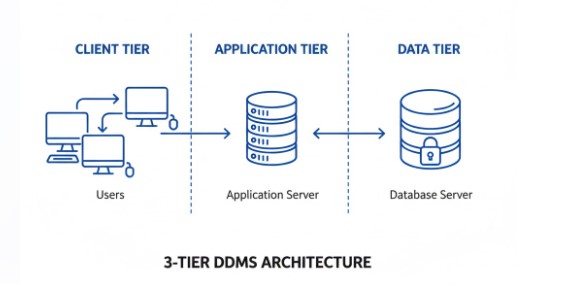
How does a database management system work? How does the user’s click reach the hard disk? The way in which all these things work is called DBMS architecture. This architecture ensures who, where, how will access or change data. I will tell you about the three architectures in DBMS: Level 1, Level 2 and Level 3.
Level 1 Architecture (Single-Tier Architecture)
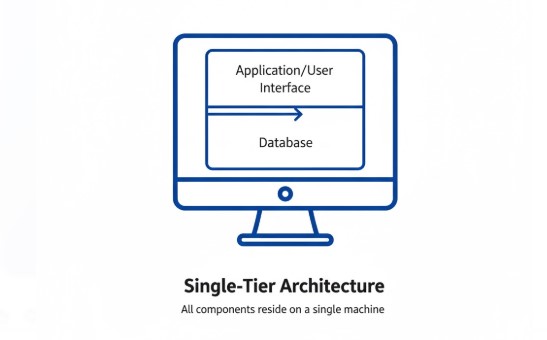
DBMS Single Tier Architecture is the simplest architecture, where the database and user interface reside on the same system. Users are connected to the database without the need for a network.
- Example: A database software installed on your computer, such as Microsoft Access, is an application that reads and writes .accdb files to your computer disk.
- Use: This application is used for general personal use and database learning.
- Advantage: This database is very easy to design and use, no network is required to store or update data in this database.
- Disadvantage: This database is not suitable for storing large amounts of data, the security of this database is very low, and data sharing is very difficult.
Level 2 Architecture (Client-Server Architecture)
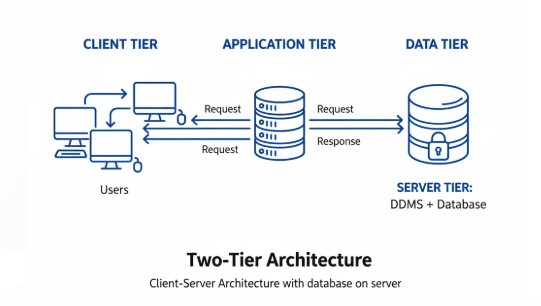
Client-server architecture or Two Tier architecture is divided into two parts: client (frontend) and server (backend):
- Client Tier: The client tier is the user interface or application. Its job is to receive requests from the user, send them to the server, and display the files received from the server to the user. (For example: PHP, Java, Python Application)
- Server Tier: The job of the server tier is to process the client’s request, retrieve or modify the required data from the database, and send the results to the client. (For example: MySQL Server, Oracle Server)
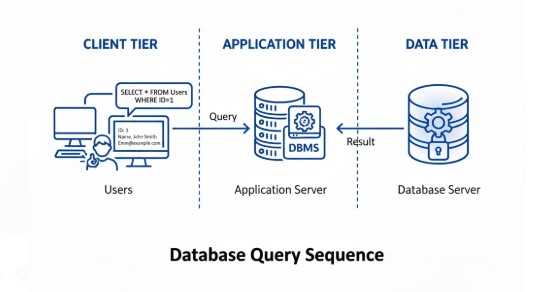
- Client-server communication: Two types of connectivity are used to communicate with the client server Open Database Connectivity (ODBC) or Java Database Connectivity (JDBC).
- Used: Currently, this network-based system is used in many small boro organizations (e.g.: Librarry Managment System and Inventery System).
- Advantage: This system allows you to store data for multiple people, good for security and central control.
- Disadvantage: If there are a large number of clients, there will be a lot of pressure on the server, and you will face a lot of difficulties while updating the client software.
Level 3 Architecture (Three-Trier Architecture)
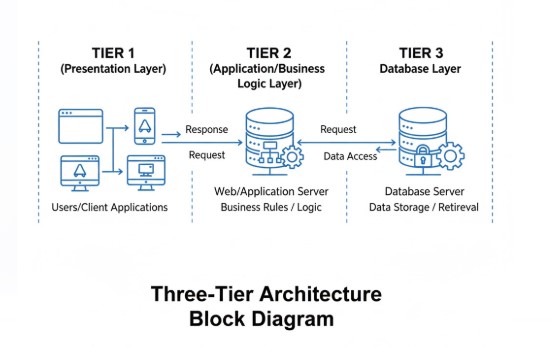
The most suitable and widely used model for modern and complex web applications. It separates the application logic into three layers:
- Presentation Layer: This layer is responsible for displaying the user interface. Its main function is to take input from the user and display the output received from the server to the client (For example: Web Browser, Moblile Apps UI).
- Application Layer: This layer implements all the business logic, rules, and processing logic. This layer receives requests from the presentation layer, processes them, communicates with the database layer for the required data, and sends the results to the presentation layer (For Example: Node.js, Django, Spring Boot server).
- Data Layer: The job of the data layer is only to be responsible for the database server and data storage (For example: PostgreSQL, MongoDB Server).
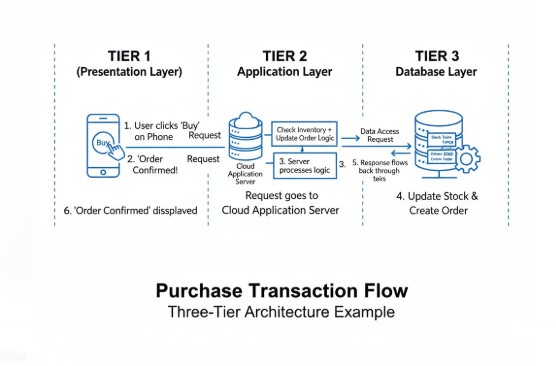
- Used: This DBMS is used in modern web applications such as Amazon, Facebook, ecommerce platforms, enterprise resource planning (ERP) systems.
- Advantage:
- Scalability: Each layer can be upgraded or scaled independently.
- Security: The database server is not directly exposed to the internet.
- Flexibility: Different clients, web and mobile, can use the same application layer
- Data Integrity: Business logic is centrally controlled.
- Disadvantage: This architecture design is complex, development and maintenance costs are high
Conclusion
DBMS architecture teaches us how a system should be based on.

